-
Daniel Clarke is a full-time EPSRC-funded
research student in the School of Engineering and Innovation
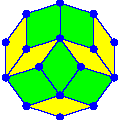
who starts in October 2021. His research topis is Design and
Validation of 3D Printed Aperiodic Cellular Structures.
Daniel's lead supervisor
is Iestyn Jowers and
he is co-supervised
with Richard Moat.
- Ibai Aedo is a full-time research
student who started in February 2019. His topic is Substitution Dynamics and
Semigroups and he will be co-supervised
by Ian
Short.
- Alex Durie is a part-time research
student who started in October 2015. His topic is Theory of Spin
Transport in Nanoscopic Materials and his lead supervisor
is Andrey Umerski.
- Valentin Fadeev was a part-time research
student who started in January 2014 and completed in August 2020 with
a thesis on Spin Transport and Exchange Coupling inBallistic
Magnetic Multilayers. Valentin's lead supervisor
was Andrey Umerski.
- Thomas Bridge was a part-time research
student between February and October 2019, co-supervised
by Ian
Short.
- Lax Chan was a full-time research student
supervised by myself,
with Ian
Short as co-supervisor. Lax started in October 2014 and completed
his PhD with a thesis on
Continuous spectra for substitution-based sequences in January 2018.
- Jonathan Keelan was a full-time research student
in Physics who started in October 2011. His
lead supervisor
was Jim Hague.
Jonathan completed his PhD in 2016 with a thesis on
Global Optimization of Organ Specific Vascular Trees.
- Steve Moon was a part-time research student in
2014/15. His project was on Quasiperiodic dynamical systems,
his lead
supervisor Ben
Mestel.
- Harry Kennard was a full-time research student
working on a project on Dynamics in Turbulence from August
2011, and during his final year was co-supervised
by Andrey Umerski. Harry
completed an MPhil in late 2013.
- Penny
Lynch started as a part-time research student in October
2004, with
Andrew Read (at the time in
Edinburgh, now at Penn State University) as external
co-supervisor. Her research is on the Mathematical Modelling of
Pathogen Life History Evolution Effects of Public and Animal Health
Interventions, and completed in 2013. Penny received the Baroness
Lee of Asheridge Award from the Association of Open University
Graduates (AOUG) in 2012.
- Manuela Heuer started as a full-time EPSRC-funded
research student in October 2006. Her topic was
Combinatorial Aspects of
Root Lattices and Words. Her co-supervisors
were Andrey Umerski
(internal) and
Michael
Baake (Bielefeld, Germany). Manuela completed successfully in 2010.
- John Urquhart was a part-time research student
from 2007 until 2010. John's topic was Criteria for measuring the
appearance and transmission of DNA mutations in a human
population, he was co-supervised by Álvaro Faria (internal)
and
Heather Cordell (Newcastle).
- William
Stevens was a part-time PhD student working
on Artificial Life. He started his PhD in January 2004 under my
co-supervision (with
Nigel Mason).
William completed successfully in 2010.
- Svenja Glied is a full-time research student at
the University of Bielefeld, Germany, supervised
by Michael
Baake (Bielefeld). Svenja is a Visiting Research Student at the
Open University until end of April 2009.
- Miguel Tierz
was a full-time research student between February and June 2004, working on
Random Matrix Theory and Chern-Simons theory.
- Tini
Garske, who had started her PhD project entitled
Models of biological evolution and statistical mechanics in
October 2001, obtained her degree in March 2005. After working at
the London
School of Hygiene & Tropical Medicine, Tini is currently a
Research Fellow at the Institute for Mathematical Sciences at Imperial
College, London.
- Przemyslaw Repetowicz
completed his PhD on
Theoretical
investigations of magnetic and electronic properties of
quasicrystals at Chemnitz University of Technology in October
2000 (supervised jointly with
Michael Schreiber).
Mechanical properties of aperiodic framework structures
With additive manufacturing (3D printing) becoming more and more
accessible, it is possible to print aperiodic structures based on
tilings with non-crystallographic symmetries, which are expected to
have more isotropic mechanical behaviour than lattice-based
structures, and thus may be of interest for applications in a a
variety of areas. The project is concerned with the development and
verification of modelling the mechanical properties of such structures.
This is closely related to the EPSRC-funded research on Novel superior materials based on aperiodic tilings.
Matrix cocycles and spectral properties of inflation systems
The diffraction measure for inflation-based structures is very
rich; it can contain pure point, singular continuous and absolutely
continuous components. The presence or absence of these components can
be studied via a matrix cocycle. This may provide a link to the
spectral properties of corresponding Schrödinger operators, which
seem to behave in a quite different way, but can also be deduced from
matrix product properties. This project is linked to EPSRC-funded
research
on Lyapunov
Exponents and Spectral Properties of Aperiodic Structures.
Mathematical diffraction of aperiodic structures
Mathematical diffraction is a method to assess the degree of order
in a structure, and is closely related to the diffraction used in
crystallography to study periodic and aperiodic crystals. The
classification of the diffraction from aperiodic structures is thus
one approach to classify these structures. The research will focus on
aperiodic structures obtained by inflation, for which there are still
many open questions, in particualr with regard to continuous
components in the diffraction spectrum.
Spectral properties of aperiodic Schrödinger operators
Aperiodically ordered quantum systems are of interest in the
theoretical description of quasicrystals, a particular kind of
ordered solid lacking the periodic structure of ordinary crystals.
Such systems exhibit rather unusual spectral properties, including
singular continuous spectra and multifractal eigenfunctions. The
work aims at unravelling the connection between spectral properties
on the one hand and quantum diffusion on the other hand, employing a
combination of analytical and numerical techniques.
Stastistical mechanics of aperiodically ordered and
disordered systems
The properties of a system at, or close to, a second-order phase
transition are assumed to be universal. Roughly, this means that they
do not depend on any particular details of the system. However,
aperiodic order or disorder, either in the coupling constants or in
the underlying discrete structure, may influence the critical
behaviour. The work comprises the investigation of the effects of
aperiodic order and disorder in classical and quantum spin models,
particularly the Ising model.
Any student who is interested to join me on one of the
above topics, or would like to know more about my research interests,
is cordially invited to contact
me!