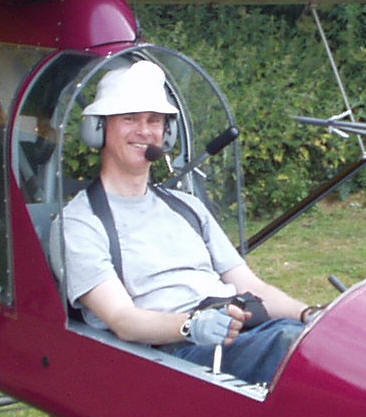
Michael Wilkinson

Department of Mathemetics and Statistics,
The OpenUniversity,
Walton Hall, Milton Keynes,
MK6 7AA,
England.

Email: m.wilkinson@open.ac.uk

Tel.: +44-(0)1908-659741

Research summary

My research work is in theoretical physics. The emphasis is on achieving a thorough understanding of physically realistic model problems using both analytical methods and numerical experiments. I have worked on problems arising in solid-state physics, quantum mechanics, statistical physics and fluid dynamics.

My best known work involves the applications of random matrix and semiclassical methods to the dynamics of complex quantum systems, and renormalisation group analysis for Bloch electrons in a magnetic field. I was awarded the Maxwell medal of the Institute of Physics in 1997 for work in the latter area. I have also contributed to understanding the response of small particles to electromagnetic fields, quantum tunnelling, and to exciton spectroscopy. Recent work in these areas includes the discovery (in collaboration with B. Mehlig, D. Cohen) of 'semilinear response', a variant of quantum linear response theory.

More recently I have worked on problems in statistical physics, mostly in collaboration with B. Mehlig: highlights include

a) Analysis of  the dynamics of particles suspended in turbulent flows. It is known that these may exhibit clustering, which has been attributed to particles being centrifuged away from vortices. Our alternative theory, based upon a mapping to a perturbation of a nine-dimensional harmonic oscillator, gives quantitative agreement with simulations using turbulent Navier-Stokes flows.

b) Generalised Ornstein-Uhlenbeck processes. A natural generalisation of the classic diffusion process can be solved by spectral decomposition: the spectrum consists of two staggered ladders, and is generated by a novel type of creation/annihilation operators.

c) Rapid onset of rainfall from cumulus clouds. It has long been suspected that this is related to turbulence inside clouds, but the mechanism was unclear. We showed that there is a dramatic increase in the rate of collisions between microscopic water droplets when the turbulence intensity passes a threshold. This is due to the activation of caustics in the velocity field of the suspended particles.

This work was featured on the Research Highlights page of Nature Physics, and on the ScienceNOW website.

Another recent area of interest is understanding the origin of planetary systems. The standard model involves aggregation of dust particles in the nebula surrounding young stars. There are compelling arguments that the gas must be in turbulent motion. We have argued that the turbulence causes aggregates to collide with a sufficiently high speed that they will be fragmented by the collision, so that the aggregates cannot grow beyond a certain size: we call this mechanism the 'Stokes trap'. Our paper on this topic proposes an alternative mechanism for planet formation.

For a list of publications and preprints, click here

Summary of career

B.Sc. in Mathematical Physics, Leeds, 1981
Ph.D. in Physics, Bristol, 1984
Weingart Fellow in Theoretical Physics, Caltech, 1984-6
Faculty member, Physics and Applied Physics, Strathclyde, 1986-2000,
(promoted to personal chair in Theoretical Solid-State Physics, 1998).
Maxwell Medal, Institute of Physics, 1997.
Professor of Applied Mathematics, Open University, 2000 to date.